

Imagine a commercial director stepping into a colleague’s buyer call at 10:15 on Tuesday. This is an illustrative scene, but the discomfort is easy to recognise. The proposal is open. The opportunity looks healthy. Then the buyer mentions the exception they agreed last week, and the director has to ask what they mean.
The strongest salesperson knows. She also knows why the buyer rejected the first package, who controls the budget and which promise would get delivery into trouble. Today she is unavailable. Everyone else has the account record. Nobody has the full commercial picture.
The buyer has to explain the business again.
I think that moment deserves more attention than another impressive AI demonstration. A service business sells confidence before it sells hours. When context disappears between people, the buyer starts wondering whether the same thing will happen after signing.
My position is simple: your best salesperson should help shape your company’s judgement. She should not have to remain its only working memory.
The expensive information is rarely the obvious information
A contact name is easy to preserve. The reason an opportunity matters is harder. So is the difference between a request, a tentative suggestion and an actual commitment. Put all three into a fluent summary and the next person may confidently do the wrong thing.
I would rather see five reliable lines than fifty beautifully generated ones: what the buyer wants, what has been verified, what we have agreed, what remains uncertain and who owns the next decision. Each important statement should point back to evidence.
Recent research gives this concern substance. Kickstand and Pavilion’s October 2026 report surveyed 603 senior B2B sales and marketing professionals in the US and UK. Only 49% reported a designated owner of AI performance across both functions; 41% reported regular cross-functional reviews and 35% shared governance. Fieldwork was conducted from 20 May to 15 June, not this week. These are reported organisational practices, not proof that any one practice causes higher sales. [Kickstand × Pavilion research]
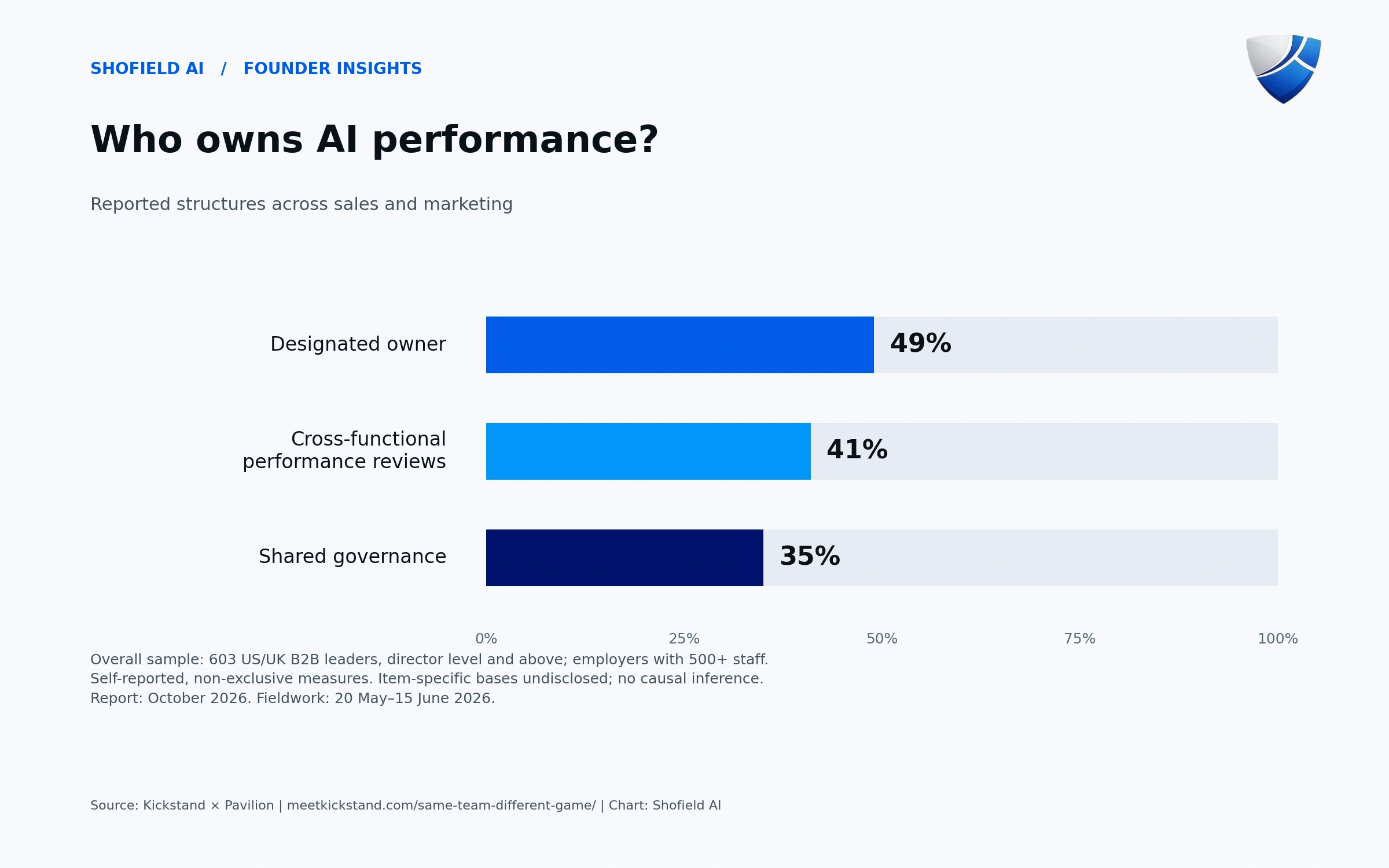
My reading is that a business can acquire considerable intelligence without deciding who is responsible for its use. That is a leadership choice. Adding another agent does not settle it.
A separate KPMG study, published on 5 October, strengthens the case for explicit ownership. Among organisations reporting established AI returns, 86% reported a formal cross-functional or enterprise-wide AI management layer, versus 31% among experimenters. The survey covered 2,131 senior leaders across 20 countries and jurisdictions, with fieldwork from 23 July to 26 August. That association does not establish causation. It does make me ask who coordinates the work after the first agent is activated. [KPMG Global AI Pulse Q3]
The useful lesson from Air India
The airline example that interests me is about coordinated work. In a 15 September 2026 announcement, Air India and its technology supplier reported reducing internal refund processing from roughly 14 days to four hours. Bank processing time was unchanged. The described workflow connected validation, approvals and backend actions. Its expanded email workflow gathered and checked information across systems before producing a consolidated response. [Air India deployment announcement]
Those are company-reported outcomes from a particular deployment, not an independent experiment or a Shofield customer result. I would not apply the airline’s time reduction to a service business. I would apply its discipline: carry the relevant facts through to the action.
For a recruitment firm, that might mean preserving an agreed hiring brief as the conversation moves from sales to account management. For a commercial maintenance business, it might mean preserving access restrictions and scope exclusions before anyone promises a visit. The customer should feel that the organisation has been listening, whoever answers next.
Give Sales AI Manager one conversation to carry forward
This is where I would start with Shofield AI’s autonomous AI workforce platform: one offer and one repeatable sales conversation. Sales AI Manager supports lead research, personalised outreach, buyer conversations and approved progression towards checkout. Available actions depend on connected channels, account eligibility and the authority you configure. [Current Shofield platform offer]
Begin with approved offer information and a small set of relevant, verified buyer facts. Decide which terms are fixed, which questions require clarification and which decisions belong to a person. Avoid importing every historical note simply because it exists. Old guesses can become expensive new instructions.
My activation test would be practical. Can a colleague understand the opportunity without calling the original seller? Can they distinguish a confirmed requirement from an assumption? Can they see the promised next step and the person responsible for an exception? Treat that as an acceptance test for your configured workflow, rather than assuming every account already behaves that way.
Shofield’s learning direction is approved context, feedback and evaluated, supported outcomes within configured permissions. It is a way to improve repeatable work while retaining control of the offer and the relationship. [Shofield learning and control]
The wider market is encountering the same boundary: current reporting describes AI agents being blocked from completing actions on websites. [TechCrunch, 6 October 2026]
For me, the commercial principle is straightforward. Knowing what a buyer wants and having permission to act are separate requirements. Design for both.
Measure the handoff before celebrating the automation
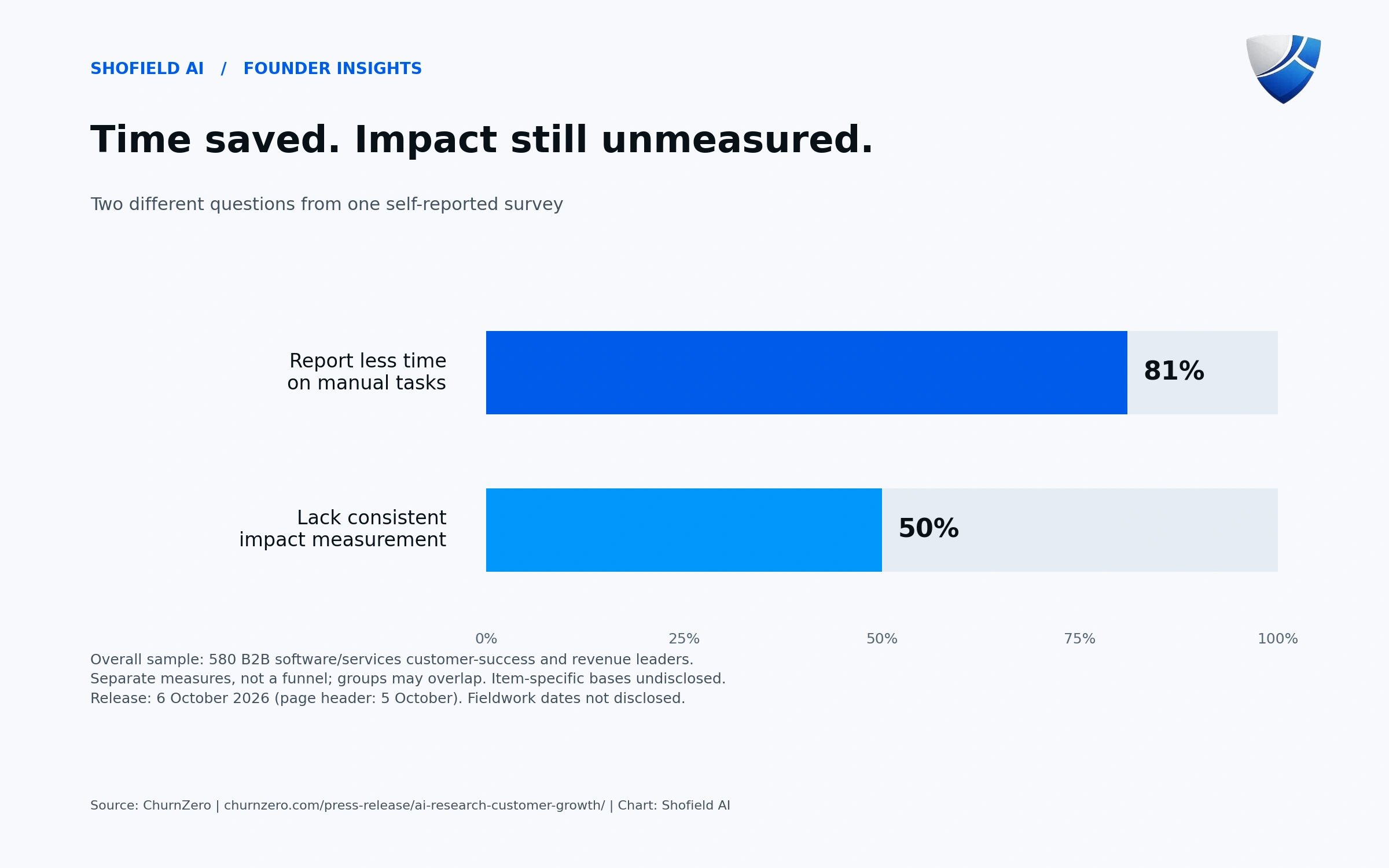
The measurement problem is visible in a second study. ChurnZero’s 2026 research covers 580 B2B customer-success and revenue leaders: 81% said AI reduced manual work, while half lacked consistent impact measurement. The announcement is dated 6 October; its page header says 5 October. Fieldwork dates are not disclosed in the summary. These are self-reports from a different population, so I would not combine them with the first survey into a single score. [ChurnZero research]
Here is an illustrative calculation for a B2B service firm, not a Shofield result or price quote. Suppose 80 qualified opportunities need a handoff each month. Reconstructing context takes 20 minutes each. A controlled workflow test brings that to eight minutes, including checking the record. The difference is 16 hours a month.
At an assumed loaded staff cost of €45 an hour, that represents €720 of capacity. It is not €720 arriving in the bank. The business must actually put those hours to useful work.
Now suppose the team wins one genuinely additional €6,000 engagement, with a 40% contribution margin after delivery costs. That creates €2,400 of contribution before the new workflow’s costs. If subscription, usage and additional review together cost an illustrative €1,000, €1,400 remains before tax and other overhead. A 50% deposit would bring in €3,000 initially; revenue recognition and the remaining payment follow the contract.
Do not add the €720 capacity value to that contribution unless it creates a separate, demonstrable benefit. Do not credit AI with a sale you would have won anyway. If the extra engagement never materialises, the commercial case must stand on the benefits you actually observe.
A better Tuesday is a testable outcome
Return to our imagined call. This time the director opens a checked account brief. The budget is unconfirmed, the exclusion is explicit and the next decision belongs to procurement. Instead of making the buyer repeat everything, the director asks the question that advances the deal.
That is the change I want to measure.
Choose twenty upcoming handoffs. Record preparation time, buyer corrections, missing commitments and whether the agreed next step happens. Compare with a similar previous group, and record differences in deal complexity. Have the receiving colleague score whether the context was usable. Twenty cases will not establish scientific causality, but they can reveal whether the workflow deserves a larger test.
Keep the experiment small enough that your strongest salesperson can review mistakes without becoming a full-time editor. Her judgement should improve the system, not become another queue of unpaid checking.
My founder outlook: the advantage will be continuity
Over the next 12–24 months, I expect the more durable advantage to come from preserving commercial judgement across a growing team. Generating persuasive language will become easier. Maintaining an accurate account of what a business knows, has promised and may do will remain demanding.
My reasoning is commercial: buyers experience the joins between people and systems. A business that remembers accurately can make those joins less costly. A business that accumulates unverified memories can make them worse at greater speed.
I would change this view if maintained context consistently failed to improve handoffs, if correction costs consumed the benefits, or if simple general-purpose tools delivered the same reliable continuity with substantially less effort. Those are signals to measure, not arguments to dismiss.
Start with Sales AI Manager at Shofield AI. The current Sales subscription trial is seven days, requires a card and renews on the price and billing period you confirm unless cancelled; usage is separate. Check eligibility and current terms before activating. [Explore Shofield AI]
If you want to discuss platform fit, message me on LinkedIn with WORKFLOW, your business type and the handoff that keeps losing context. Bring one real bottleneck. Let’s identify the first platform workflow worth putting to work. [Try Shofield AI] [Richy Shofield on LinkedIn]
Sources and methodology
- KPMG — Global AI Pulse Q3 2026 — 2026-10-05. 2,131 senior leaders across 20 countries, territories and jurisdictions; fieldwork 23 July–26 August. Observational self-report; subgroup sizes not given in summary. Association is not causation.
- Kickstand × Pavilion — Same Team, Different Game — 2026-10. Report explicitly dated October 2026. Launch described by coauthor at GTM2026 (28 September–1 October); exact day unavailable. CMS page creation 3 September precedes report launch and is not treated as publication. Fieldwork 20 May–15 June; 603 US/UK directors+ at B2B employers with 500+ staff; self-report, observational; no small-business representativeness claim.
- ChurnZero — 2026 Customer Revenue Leadership Study — 2026-10-06. Release dateline 6 October, page header 5 October. n=580 B2B software/services leaders; self-report; summary does not disclose fieldwork or item-specific bases.
- Air India / Salesforce — deployment announcement — 2026-09-15. Company-reported internal refund timing; bank time unchanged. No independent causal audit or Shofield relationship claimed.
- TechCrunch — agent access coverage — 2026-10-06. Discovery/context only.
- Shofield AI — current platform and trial terms — 2026-10-09. Checked 9 October; retrieval date, not original publication. Platform-only offer.