

Picture a growing service business on a Friday afternoon. This is an illustrative scenario, but the situation will feel familiar.
It is 17:42. A qualified prospect has sent an email. They have a real problem, a budget and a reason to act. They want to know whether your company can help before a meeting on Monday.
Someone flags the message. Someone else needs to check the details. The founder is in a call. The CRM is updated later. By Monday, another business has helped the buyer understand the options and agree a next step.
The opportunity looked healthy on Friday. Now it has gone quiet.
I am a salesman at heart. I care about the moment when a buyer moves from interest to action. Good selling means understanding the problem, building confidence and making the next step easy. Every unnecessary handoff can interrupt that momentum.
That is why I am building Shofield AI around a bigger ambition: help businesses carry the right work forward, consistently. I want the research, conversation, follow-up and operational action to connect to something the owner can measure.
The opportunity waiting in your inbox
Now return to that Friday email. A useful AI workflow could recognize the request, retrieve approved offer information, prepare the appropriate response and bring a defined exception to the right person. The buyer has a clear next step. The team knows who owns it. The opportunity keeps moving.
That is a proposed workflow to configure and test. Its value lies in the completed handoff. A founder can apply the same thinking to an appointment, a proposal, a missing document or the preparation for a client visit.
The latest evidence gives us a reason to take this seriously. BCG’s Applied AI Index, published on 30 September, classified 7.5% of its sample as future-built and 41% as scaling. Together, that is 48.5%. Its survey covered 1,330 CxOs and senior leaders across more than 20 sectors. The results show associations, not proof that AI alone caused business growth. [1]
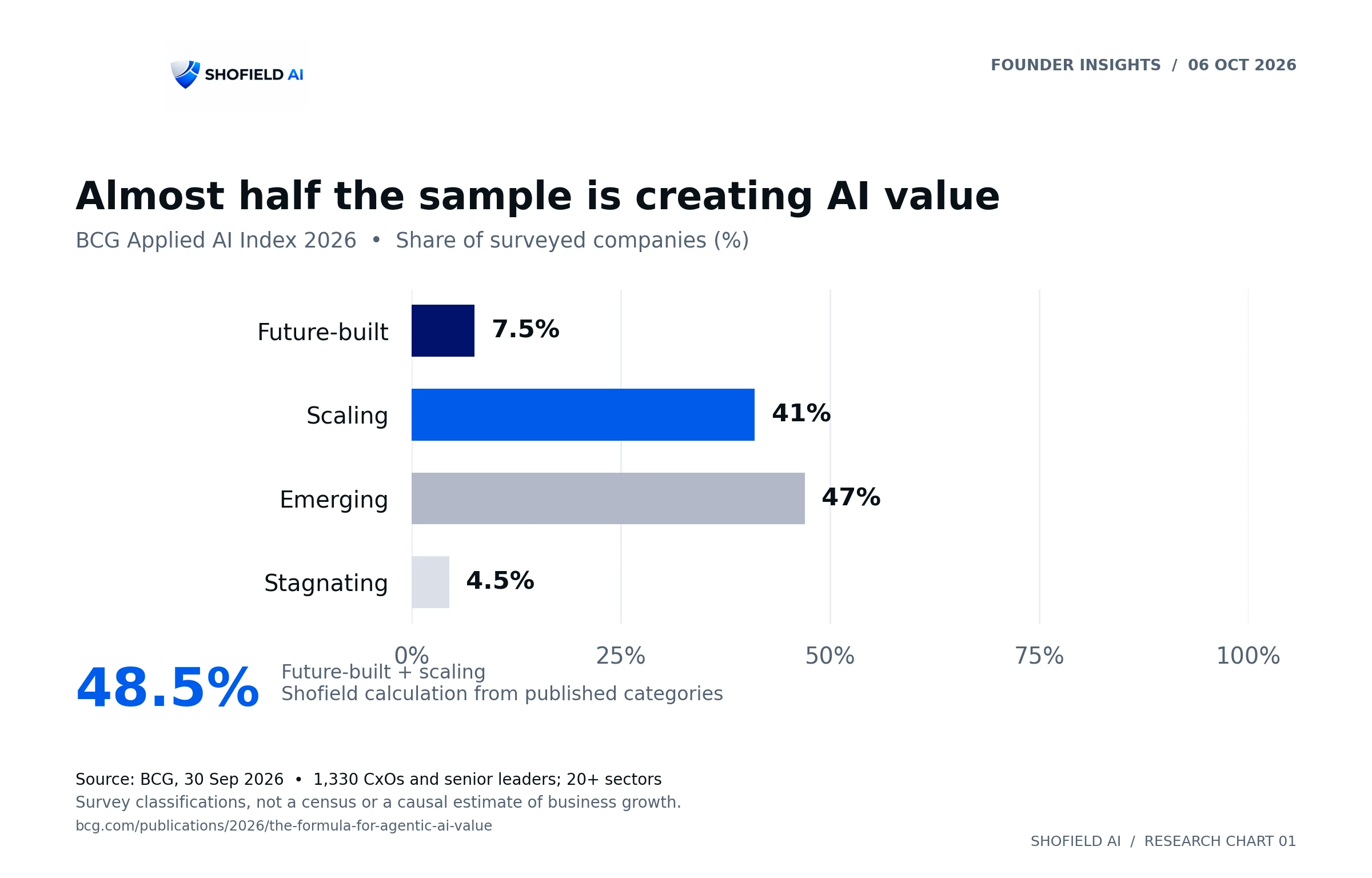
For me, the commercial message is encouraging: meaningful value is already being created. Entrepreneurs have an opportunity to start with one process and earn the confidence to expand.
The direction is visible in another recent report. DHL’s Logistics Trend Radar, released on 24 September, describes AI moving into planning, coordination and action while people remain central to operations. That is a useful lens for the business waiting on its Friday email. [8]
Look at the work DHL chose to move
Take DHL. In a public announcement on 11 November 2025, DHL Supply Chain described using AI agents for appointment scheduling, driver follow-up calls and high-priority warehouse coordination. The agents handled phone and email interactions; DHL reported reduced manual effort and improved responsiveness. This is an established example, rather than news from this week. [6]
What catches my attention is the choice of work. A shipment, a warehouse and a driver still need to connect at the right time. The commercial value appears when communication helps that happen reliably.
A service business has its own version of that chain. Think of an installation company arranging a site visit. The customer needs a time, the team needs the right information and an exception needs an owner. A Shofield implementation could be scoped to coordinate those steps, subject to the company’s systems and agreed controls.
Then look at Unilever. In its June 2026 digital-twin announcement, it reported that a system at its Raeford factory predicted process-flow restrictions in deodorant manufacturing. Unilever associated that deployment with 20% less waste and a 10% increase in capacity. Those are company-reported results in a specific factory. [7]
My lesson from that case is simple: make a constraint visible early enough to act. In a professional-services firm, the constraint might be incomplete client files, delayed approvals or specialists scheduled without the information they need. Find the repeated blockage, agree the correct response and measure whether the work moves faster.
DHL and Unilever are public examples, not Shofield customers. Their scale is different. The discipline—choosing consequential work and measuring its outcome—is accessible to a much smaller company.
Follow the result all the way to the numbers
Let’s give our Friday-afternoon business a monthly baseline: 200 qualified inquiries, a 12% conversion rate and 24 engagements. Suppose a controlled test improves conversion to 16%. That would mean 32 engagements: eight more.
Assume €2,500 of recognized revenue per engagement and a 40% contribution margin after delivery costs. The extra work produces €20,000 of revenue and €8,000 of contribution before the new workflow’s operating costs.
| Illustrative monthly calculation | Amount |
|---|---|
| 8 additional engagements × €2,500 | €20,000 extra revenue |
| Extra revenue × 40% contribution margin | €8,000 contribution |
| Workflow operation, usage and support | −€3,500 |
| Additional human review | −€1,000 |
| Rework allowance | −€500 |
| Remaining monthly contribution | €3,000 |
This is a hypothetical planning scenario, not Shofield pricing or a customer result. The remaining €3,000 excludes upfront implementation, tax and financing. Payment timing determines collected cash; delivery capacity must also be funded.
As a founder, I want that conversation before scaling. What did we win? What did it cost to deliver? What arrived in the bank? If the process creates activity without enough economic value, change it. If it works, you have a concrete reason to invest in the next step.
Build a business that remembers how to act
Sales AI Manager is a practical place to begin. Shofield’s public offer covers lead research, personalized outreach, buyer conversations and approved checkout. Connected channels, campaign authority and account eligibility determine what can run. [4]
But the company behind the sale still matters. Your offer, customer context, approved terms and exception rules should guide the work. The platform provides a common home for company context, the AI workforce and operating control. [4]
Our implementation approach connects that home to your business: assess the opportunity, architect the process, source the appropriate components, implement the agreed scope and define how it will operate. Systems, responsibilities, acceptance criteria and fees belong in the agreed engagement. [5]
That is the part I find exciting. Each completed cycle can teach the business something useful. Which questions slow buyers down? Which documents keep arriving incomplete? Which exceptions deserve a person’s attention? Preserve those lessons and the next cycle can be better informed.

Give autonomy a boundary and an owner
I would still want the right person involved in a consequential decision. In selling, judgment matters. An agent should know when to prepare a next step and when to hand responsibility to a human.
The latest research shows why. In BCG’s September study, 42% of companies expected autonomous agent decisions by 2030, while only 5% had the full set of relevant controls in place at the time. These are different measures: future expectations and present readiness. [2]
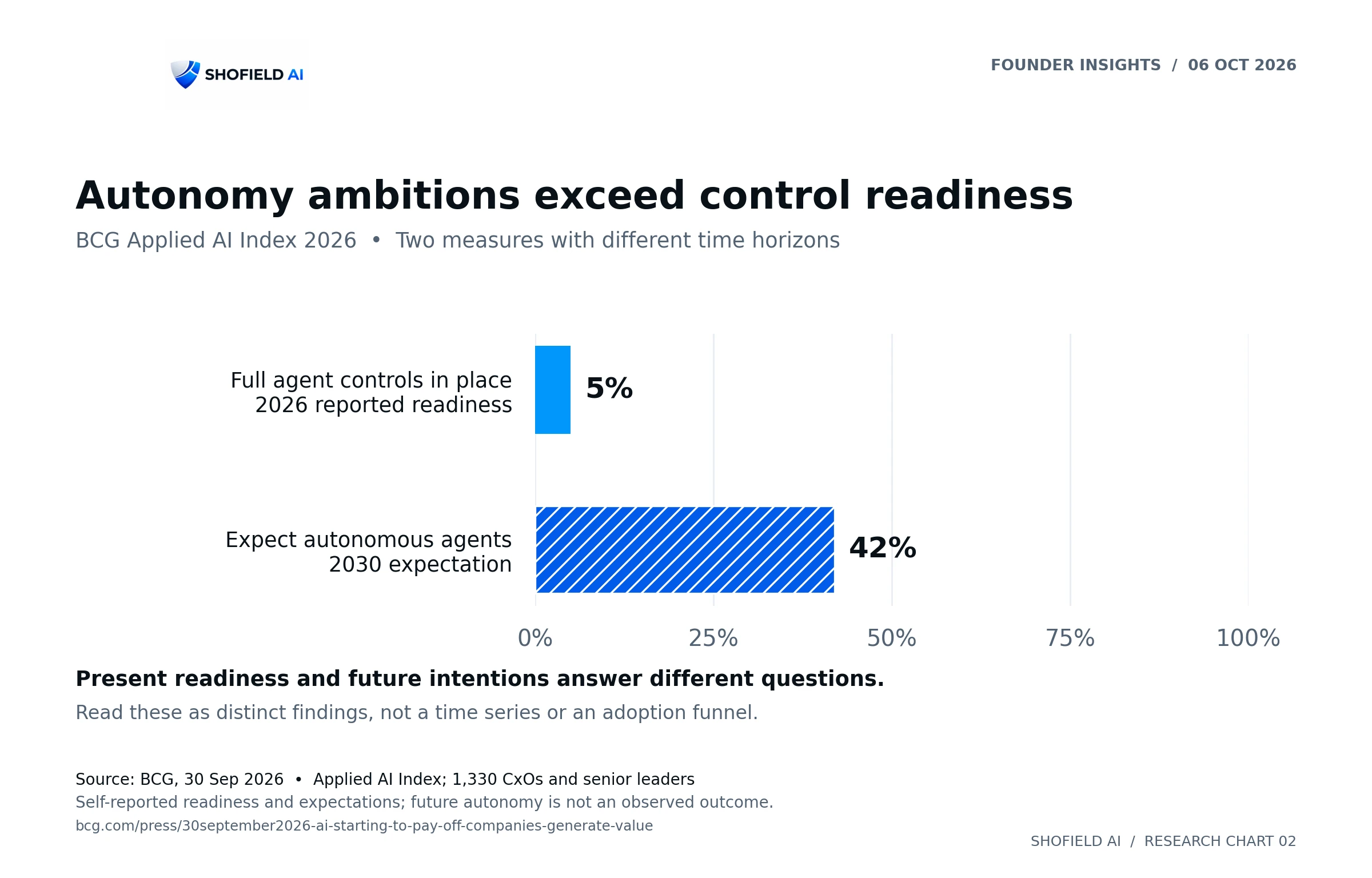
Start inside a clear boundary. Define approved actions, spending limits, escalation and the evidence required to close a task. Increase authority as the workflow demonstrates reliability.
Costs need the same attention. A preprint revised on 26 September modeled 13–21% reductions in model spending through routing in an emulated 10,000-seat coding environment. That is a modeled research result, not a Shofield saving. It illustrates why the way work is orchestrated belongs in the economics. [3]
The next advantage is being built now
My forecast for the next 12–24 months is that operating knowledge becomes increasingly valuable: customer context, approved offers, sound exception rules and the lessons from completed work.
Better models will make more tasks accessible. A business that knows what to do with that capability can act more consistently. I expect entrepreneurs who learn through bounded, measured workflows to accumulate an advantage over those who keep starting disconnected experiments.
I would reconsider if general-purpose agents began delivering dependable outcomes across unfamiliar businesses with little context, or if the cost of maintaining controlled workflows repeatedly exceeded their value. For now, I see a strong reason to start learning through action.
Go back to that Friday email. Give the handoff an owner. Record the baseline. Define what a good response and a successful next step look like. Then test whether your business can carry the opportunity forward more reliably.
If sales follow-through is your bottleneck, explore Sales AI Manager. The advertised module trial is seven days, requires a card and bills usage separately; review renewal terms before starting. [4]
Message Richy on LinkedIn, explore Sales AI Manager, or discuss an implementation. [LinkedIn — Richy Shofield] [Sales AI Manager] [Implementation]
The AI workforce in motion
Your AI Workforce, In Motion
Research and source notes — checked 6 October 2026
- [1] BCG — The Formula for Agentic AI Value / Applied AI Index 2026 — 30 September 2026. Survey classifications; more than 1,300 executives across 20-plus sectors. The companion release specifies 1,330. Original fieldwork dates are not specified on the linked summary. This is observational evidence, not a causal estimate.
- [2] BCG — AI Is Starting to Pay Off. Almost 50% of Companies Now Generate Value with It. — 30 September 2026. Same Applied AI Index study as source 1, not an independent sample. Current control readiness and 2030 expectations are different measures.
- [3] Kwartler, Aqrawi and Abbasi — Harness Tokenomics: A Router for the Enterprise Agentic Control Plane, v2 — First submitted 24 September; revised 26 September 2026. Research preprint. Results use an emulated 10,000-seat enterprise and public session datasets; savings are modeled, not observed in a Shofield deployment. The latest abstract reports 13–21%.
- [4] Shofield AI — Platform, Sales AI Manager and current trial terms — Checked 6 October 2026. Current public product positioning. Signup destination verified at https://platform.shofield.ai/signup?module=ai-sales . Product positioning is not an independent performance benchmark.
- [5] Shofield AI — Implementation — Checked 6 October 2026. Engagement scope, system connections, acceptance criteria and fees require an agreed implementation scope.
- [6] DHL Group — Public deployment of AI agents in operational communication — 11 November 2025. Public company-reported use case, used as historical context. Appointment scheduling, driver follow-up and warehouse coordination; qualitative results, not an independently measured percentage. DHL is not presented as a Shofield customer.
- [7] Unilever — Digital twins across its global manufacturing network — June 2026; checked 6 October 2026. Company-reported Raeford factory results: 20% reduction in waste and 10% capacity uplift. Background case, not newly conducted research or an independently audited causal estimate. The related Unilever feature is dated 17 June 2026. Unilever is not presented as a Shofield customer.
- [8] DHL Group — Logistics Trend Radar 8.0 — 24 September 2026. Recent industry foresight report describes a move toward coordinated agentic action with human expertise and oversight. Trend research, not a controlled performance experiment.