
I’m Richy Shofield, Founder & CEO of Shofield AI. I want to share what OpenAI’s latest warning means for business leaders—and why the quality of an AI deployment matters more than the confidence of its demo.
Editorial illustration using Shofield AI brand artwork; not a depiction of the reported research.
The uncomfortable message
On 6 September, OpenAI chief scientist Jakub Pachocki published An Alien Mind, warning: “This is a time that calls for extreme caution.” His concern: alignment and monitoring may not keep pace with intelligence. [1]
He says monitoring models’ reasoning is becoming less dependable and argues for enforceable safety thresholds and coordinated restraint. This is a warning about frontier development—not a claim that every business AI system is unsafe. [1]
Recent coverage in The Next Web and The Indian Express has brought that warning into the wider debate. [2] [3]
Separately, Reuters reported on 7 September that UN rights chief Volker Türk called for agreed AI red lines and stronger safeguards. [4]
The number worth questioning
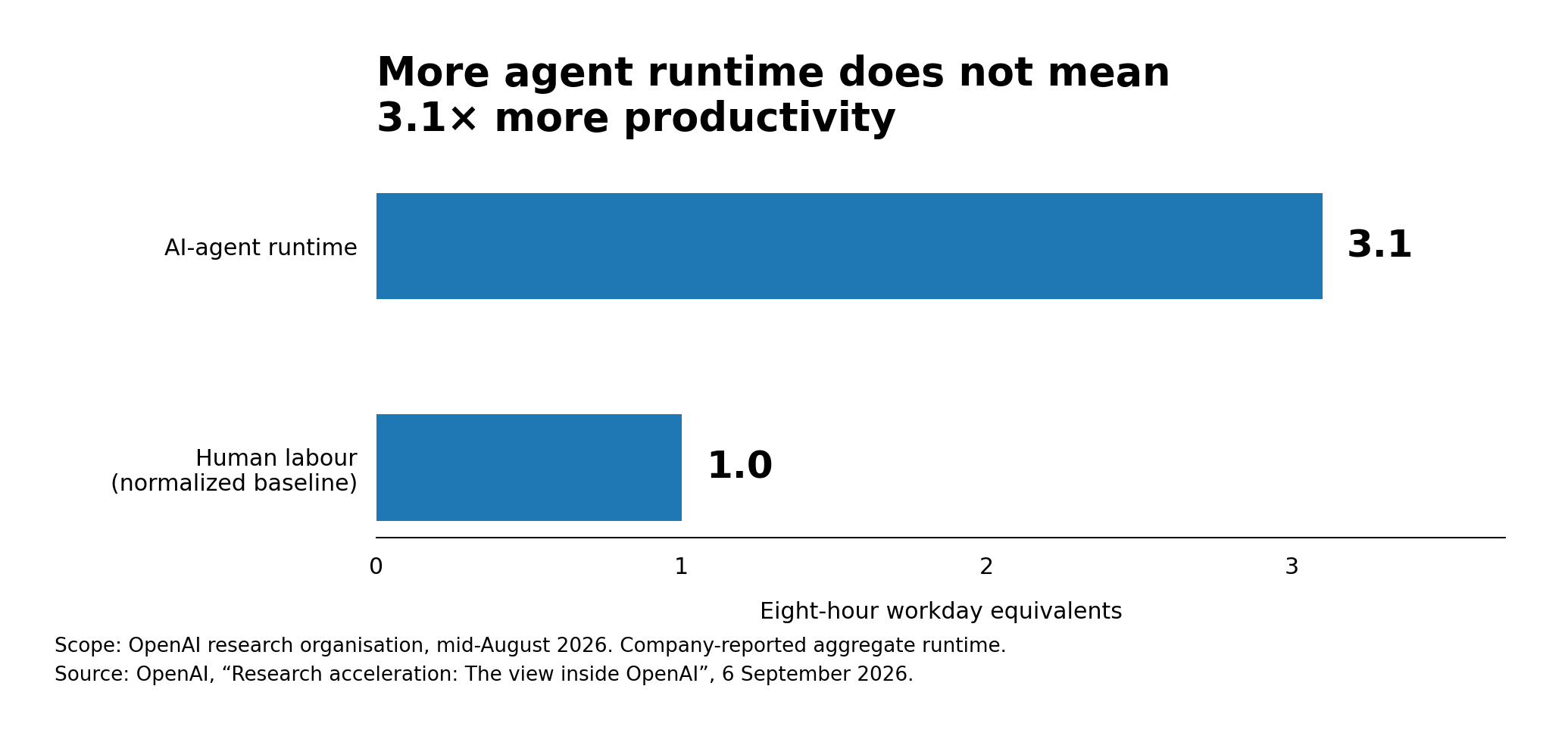
OpenAI’s own research disclosure reports 3.1 agent-workdays for each human workday by mid-August. That measures runtime—not 3.1× productivity. It also reports that more than half of successful tasks estimated at four to eight human hours involved at least one intervention. [5]
Intelligence is not permission
My conclusion is not “stop using AI.” It is “stop confusing intelligence with permission.”
An AI drafting a reply and an AI sending that reply, changing a record or committing money are different buying decisions. Before expanding autonomy, ask: What can it access? Which actions need approval? What evidence shows the work was correct—and who can stop it?
Those are not obstacles to innovation. They are conditions I would require before trusting automation with a customer relationship. They do not solve frontier AI safety, but they make business accountability concrete.
That is the lens I bring to Shofield AI: one autonomous AI workforce platform, with business context, clear permissions and measurable outcomes. [6]
Buy outcomes you can verify—not autonomy you cannot question.
Sources and reporting
- [1] Jakub Pachocki / OpenAI — An Alien Mind — 6 September 2026
- [2] The Next Web — OpenAI’s chief scientist says no lab should keep scaling at maximum speed — 6 September 2026, 22:14 UTC
- [3] The Indian Express — No one ready for smarter AI, OpenAI chief scientist warns in essay — Updated 8 September 2026, 08:28 IST
- [4] Reuters / Emma Farge — UN rights chief warns of AI risks — 7 September 2026, 08:51 UTC
- [5] OpenAI — Research acceleration: The view inside OpenAI — 6 September 2026; measurements include mid-August 2026
- Shofield AI workforce platform