
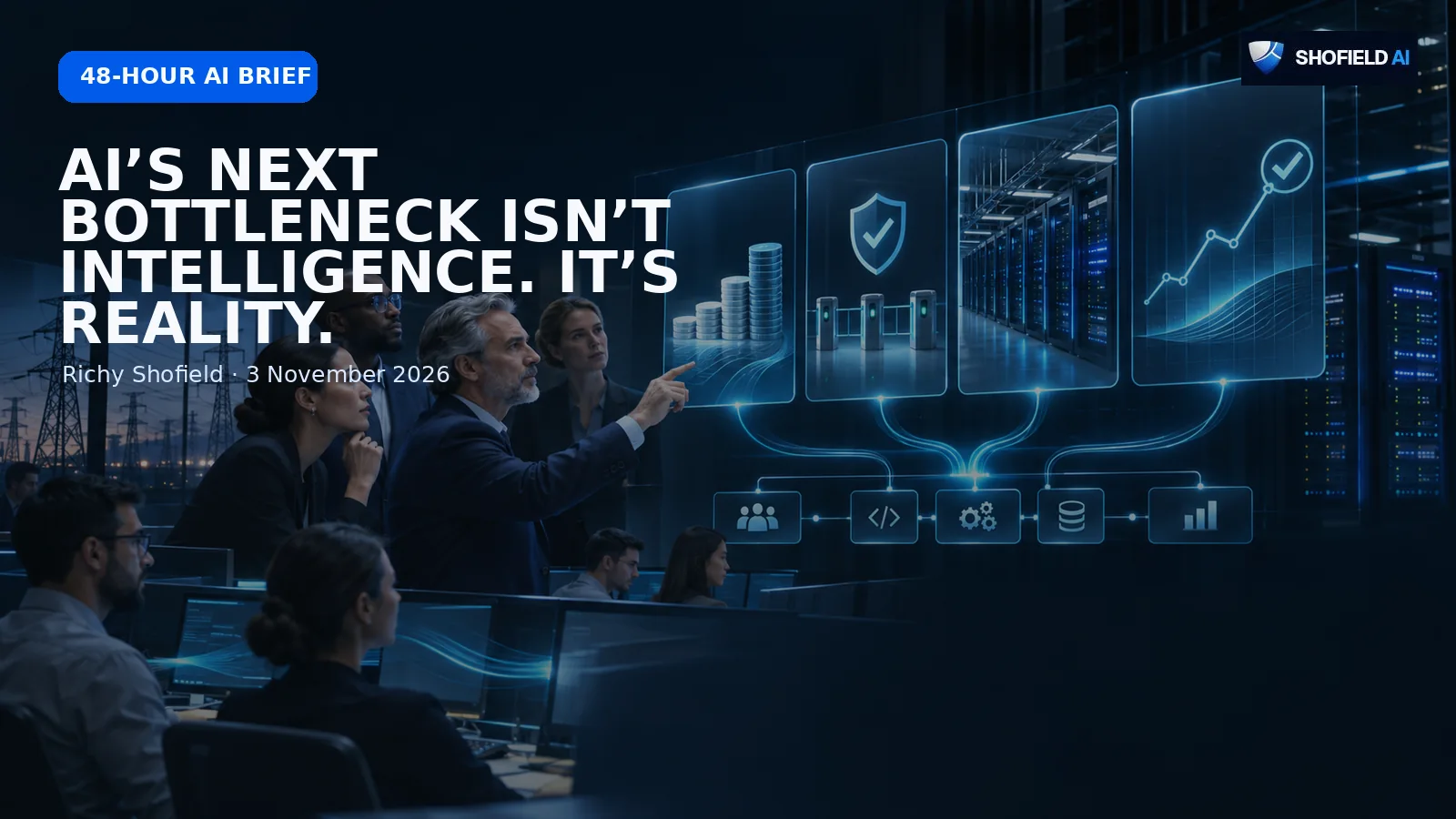
AI’s next bottleneck is not intelligence. It is reality: finite capital, contested infrastructure, fragmented permissions, regulatory boundaries and the stubborn requirement to prove that a system improved an outcome. During the 48 hours ending 3 November 2026 at 05:01 UTC, the industry produced striking technical progress. It also exposed how quickly ambition collides with financing, access rules, copyright claims and physical-world economics.
This edition ranks ten developments from ten established technology publications by business relevance, impact, evidence and novelty. Company announcements, reported plans, legal allegations and early research are distinguished from verified results. The pattern matters for leaders: capability is spreading faster than the authority and operating discipline needed to use it. The strongest AI strategy is increasingly the one that can connect a capable model to permitted work, measurable outcomes and a reliable stop path.
1. The AI buildout is meeting a capital constraint
The financing pool behind the AI boom is becoming more selective. OpenAI reportedly reduced a funding target, Meta’s credit outlook was cut to negative, and large lenders are nearing exposure limits even as hyperscalers plan extraordinary infrastructure spending. Estimates cited in the analysis suggest data centers may need far more cumulative revenue by 2030 than current enterprise and consumer AI forecasts can support. These are projections, not a forecast that investment stops; stronger borrowers may keep attracting capital while weaker projects face harsher economics. [Fortune · 2 Nov 2026, 18:12 UTC]
Business implication: treat compute commitments as investments that need utilization, margin and downside cases. Demand a credible route from model activity to cash-generating work before expanding capacity.
2. Anthropic’s revenue surge comes with infrastructure exposure
Anthropic’s amended registration filing put quarterly revenue at $17 billion, more than eleven times the prior-year period, while quarter-on-quarter growth slowed to 47%. The company also recorded major hardware and charitable-program charges, returned to an operating loss on a reported basis and disclosed vast infrastructure commitments. The filing presents a business scaling at exceptional speed, but also one whose economics depend on long-dated compute, capital and continued demand. Benchmark comparisons and IPO valuation targets remain market or company claims rather than guarantees. [SiliconANGLE · 2 Nov 2026, 23:19 UTC] [Anthropic S-1/A · filed 2 Nov 2026]
Business implication: separate growth from resilience. Evaluate gross margin, committed capacity, concentration and the cost of safety and research—not revenue momentum alone.
3. ADNOC moves frontier AI into integrated industrial decisions
ADNOC, G42 and OpenAI signed a multi-year partnership to connect field planning, capital, logistics, sales and trading decisions across the energy company. The initial applications are intended to combine decades of well and reservoir data with commercial constraints, while consequential decisions retain human oversight. ADNOC says it already uses more than 200 AI applications and has deployed ChatGPT Enterprise to over 40,000 employees. The scale is significant, but claims about faster planning and future value are partnership expectations until measured in operation. [Reuters · 2 Nov 2026, 06:40 UTC] [ADNOC partnership announcement]
Business implication: enterprise value will come from joining operational and commercial context, then testing whether decisions improve. Integration scope and evaluation matter more than model prestige.
4. Publishers challenge the AI data supply chain in court
The New York Times and three other newspapers sued Brave Software, alleging that its index scraped copyrighted articles, supplied content to AI companies and supported paywall circumvention without permission. Brave and several named companies had not responded at publication time; Perplexity rejected the characterization. The complaints are allegations, not findings of liability. Their importance is architectural: an AI company can inherit legal and provenance risk through a data intermediary even when it did not operate the crawler itself. [The Verge · 2 Nov 2026, 17:51 UTC] [Reuters case summary]
Business implication: record where retrieved content came from, what licence or permission applies and which supplier handled it. A contract does not erase provenance risk.
5. Your permission does not guarantee an agent can complete the task

Shopping and service agents are colliding with CAPTCHAs, access policies and deliberate blocks. Amazon, banks, airlines and marketplaces have commercial and security reasons to control automated access; ordinary bot defenses can also stop agents a site might otherwise accept. Cloudflare now lets site owners distinguish search, training and real-time agent traffic. The central issue is mutual authorization: a user may authorize an agent, but the destination still decides whether and how that agent may transact. [Engadget · 2 Nov 2026, 19:00 UTC] [Cloudflare agent-access policies · updated 2 Nov 2026]
Business implication: design for graceful handoff. Preserve task state when authentication, consent or policy requires a person, and measure completed outcomes rather than attempted clicks.
6. Apple’s China rollout shows that AI products are regional architectures
Apple Intelligence is scheduled to reach Chinese iPhones in December through iOS 27.3, with Alibaba’s Qwen supporting selected Siri, writing and visual-intelligence functions. The first release excludes the newer Siri AI and some features, and other Apple platforms await approvals. Apple says users can choose whether to send a request to Qwen and that Alibaba will not use those requests for training. The launch illustrates that a global AI product can require different models, approvals and feature boundaries by market. [Computerworld · 2 Nov 2026] [Apple China announcement · 31 Oct 2026]
Business implication: make region, data path, model provider and feature eligibility explicit. “Available globally” is no substitute for tested local behavior and compliant operations.
7. OpenAI’s data-center problem is becoming a trust problem
OpenAI is preparing to describe large data centers as “AI compute campuses” while arguing that communities should receive tangible benefits. The proposed language arrives amid political resistance to energy use, environmental effects and opaque local agreements. Separately, OpenAI launched a Grid Protectors Program promising future campuses could reduce demand when grids are strained. A new label will not prove affordability or public value; the test is whether contracts, grid behavior and community outcomes support the promise. [TechCrunch · 1 Nov 2026, 21:55 UTC] [OpenAI Grid Protectors Program · 2 Nov 2026]
Business implication: social licence is operational infrastructure. Publish measurable commitments on cost allocation, energy, water, jobs and emergency flexibility instead of relying on branding.
8. Apple’s reported home robot still lacks a decisive job
Apple is reportedly targeting a $1,000-plus mobile home device for 2027 or 2028 that could support FaceTime, switch lights and respond to its surroundings. The project is described as having roughly 300 software staff but only about ten specialist roboticists, with internal debate over which functions justify the price. Apple has not announced the product, so timing, name and capabilities remain reported plans. The larger lesson is familiar: autonomy without a valuable job is an expensive demonstration. [Ars Technica · 2 Nov 2026, 18:32 UTC]
Business implication: define the recurring outcome before choosing embodiment. Hardware multiplies safety, support and service costs; novelty is not product-market fit.
9. AI is beginning to edit other models at the weight level

MIT CSAIL researchers used GPT-6 Astra to inspect and directly modify a small Qwen model’s weights, raising its MATH-500 score from 7.9% to 48.1% while changing about 0.016% of parameters. The gain largely came from correcting a repetition failure, and finding the patch required extensive investigation. A follow-up on another model did not establish a comparable improvement. The work demonstrates promising model repair, not recursive self-improvement or a general replacement for training. [VentureBeat · 2 Nov 2026, 22:16 UTC] [MIT CSAIL research post · 2 Nov 2026]
Business implication: treat every patch as a new model version. Re-test representative tasks, inspect unintended changes, preserve rollback and compare the total repair cost with simpler fixes.
10. AI may turn obscure legal gaps into scalable attack surfaces
Legal researchers used language models to identify possible authorization gaps in German regulations and warned that increasingly capable systems could discover exploitable statutory inconsistencies at scale. The examples are research claims requiring human legal review; courts may interpret around defects and legislatures can repair them. Even so, the analogy to software security is useful: cheap automated reasoning may increase the volume of adversarial legal analysis faster than institutions can respond. [The Register · 2 Nov 2026, 21:16 UTC] [Stanford Law report · 28 Oct 2026]
Business implication: use AI to stress-test policies and contracts, but require qualified review before treating a discovered “loophole” as valid, material or safe to act on.
The common thread is not a slowdown in intelligence. It is a shift in competitive advantage. Capital must be justified, data must be licenced, agents need reciprocal access, regional products need explicit architecture and model changes need validation. Businesses that can turn those constraints into controlled operating systems will learn faster from supported outcomes—and waste less money chasing capability without permission or proof.